Curated Resources on Interprovincial Social Determinants of Health Frameworks
Introduction
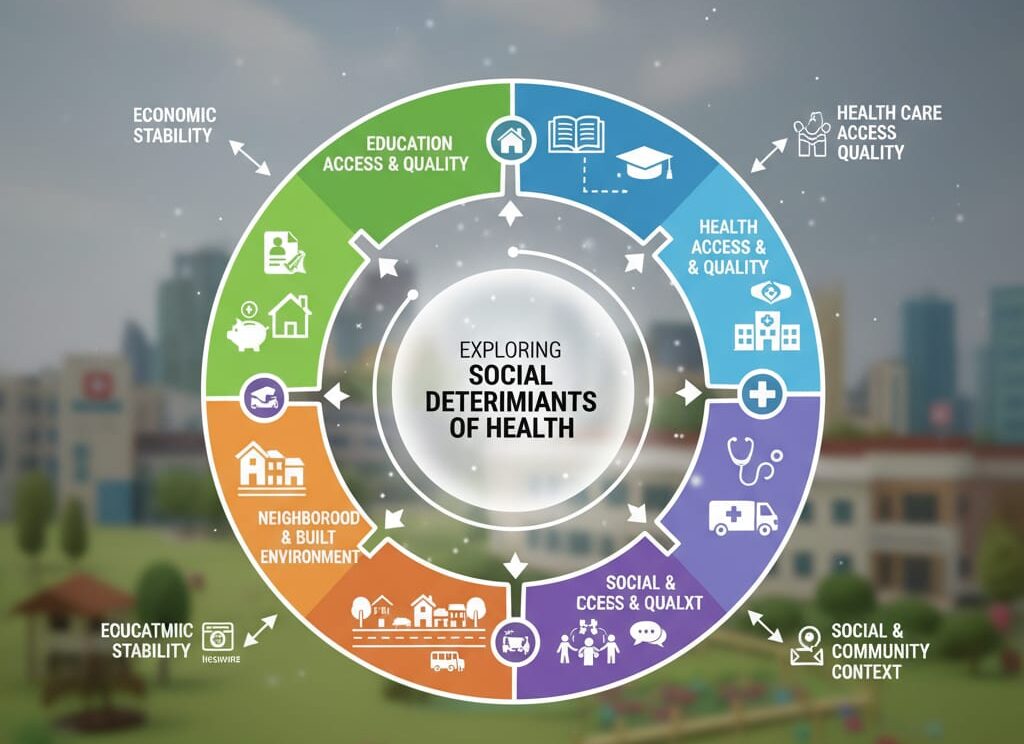
For this interprofessional activity, I collaborated with a registered nurse from British Columbia to compare how Ontario and British Columbia define, prioritize, and operationalize the social determinants of health (SDoH). This curated collection highlights provincial differences in policy and practice, while emphasizing how both structural and frontline frameworks contribute to equitable healthcare. Each resource was selected to strengthen my understanding of how systemic choices, frameworks, and professional roles shape health equity outcomes in Canada.
Scholarly Resources:
1. Social Determinants of Unmet Need for Primary Care: A Systematic Review (Canadian Evidence)
Alemu, F. W., Raji, S. D., Anderson, C., Khan, S., & Wong, S. T. (2024). Social determinants of unmet need for primary care: A systematic review. Systematic Reviews, 13, 252. https://doi.org/10.1186/s13643-024-02647-5
Annotation:
This Canadian review demonstrates how income, mental health, and chronic conditions influence access to primary care. It was included to support the shared national goal across provinces of addressing inequities through evidence-informed frameworks.
2. Social Determinants of Health in Canada: Are Healthy Living Initiatives There Yet?
Gore, D., & Kothari, A. (2012). Social determinants of health in Canada: Are healthy living initiatives there yet? International Journal for Equity in Health, 11(1), 41. https://doi.org/10.1186/1475-9276-11-41
Annotation:
This article critically evaluates Canadian health initiatives addressing SDoH. It was included to illustrate both the successes and gaps in national and provincial strategies for operationalizing health equity.
Government Resources:
1. Social Determinants of Health and Health Inequalities (Canada, National Context)
Government of Canada. (2023). Social determinants of health and health inequalities. Public Health Agency of Canada. https://www.canada.ca/en/public-health/services/health-promotion/population-health/what-determines-health.html
Annotation:
This federal resource offers a national perspective on SDoH and health inequalities. It was included to contextualize both Ontario and BC frameworks within Canada’s broader policy environment.
2. Ontario Health Social Determinants of Health Framework & Resource Guide (Provincial Implementation, Ontario)
Ontario Health. (2025). Ontario health social determinants of health framework & resource guide. https://www.ontariohealth.ca
Annotation:
This framework provides actionable guidance for embedding equity into frontline practice in Ontario. It was included again to illustrate the practical tools available to health organizations, such as the HEIA and Indigenous Lens Tool, which translate high-level policy into measurable, local outcomes.
3. Ontario Public Health Standards 2021 (Regulatory Framework, Ontario)
Government of Ontario. (2021). Ontario public health standards 2021. Ontario Ministry of Health. https://www.health.gov.on.ca/en/pro/programs/publichealth/oph_standards/docs/ophs_2021.pdf
Annotation:
This document outlines SDoH expectations as part of Ontario’s provincial public health standards. It was included to show how policy establishes the accountability framework for organizations to operationalize health equity in daily practice.
4. B.C. Social Determinants of Health Value Set (Provincial Framework, British Columbia)
Government of British Columbia. (2024, September 4). B.C. social determinants of health value set. https://www2.gov.bc.ca/gov/content/health/practitioner-professional-resources/health-information-standards/standards-catalogue/bc-social-determinants-of-health-standards
Annotation:
This BC publication standardizes SDoH data collection and reporting across health systems, enabling consistent population-level monitoring. It demonstrates BC’s focus on structural integration and system-wide accountability for equity and reconciliation.
5. Cultural Safety & Humility Standard (HSO 75000:2022, British Columbia)
Government of British Columbia. (2022). Cultural safety & humility standard (HSO 75000:2022). https://www2.gov.bc.ca/gov/content/governments/technology-innovation/standards/cultural-safety
Annotation:
These standard mandates culturally safe care and Indigenous cultural safety training across BC’s health system. It exemplifies how equity is structurally embedded and operationalized at a provincial level.
Organizational and Policy Tool Resources:
1. Health Equity Impact Assessment (HEIA) Tool (Applied Equity Assessment, Ontario)
Ministry of Health and Long-Term Care. (2012). Health equity impact assessment (HEIA) tool. Ontario Ministry of Health. https://www.health.gov.on.ca/en/pro/programs/heia/
Annotation:
The HEIA tool supports organizations in evaluating how programs and policies impact equity. It’s included to show how Ontario operationalizes its SDoH framework in a systematic, data-informed way to identify and mitigate inequities.
2. Indigenous Lens Tool (Culturally Informed Framework, Ontario)
Jumah, R., Smith, M., & Ontario Health. (2023). Indigenous lens tool: Aligning health equity frameworks with Indigenous perspectives. https://www.ontariohealth.ca
Annotation:
This tool guides Ontario organizations to embed Indigenous perspectives into policy and program planning. It complements the HEIA by providing culturally specific guidance, demonstrating Ontario’s emphasis on actionable, frontline equity tools.
3. Health Equity Guideline (Policy Direction, Ontario)
Ministry of Health and Long-Term Care. (2018). Health equity guideline. Ontario Ministry of Health and Long-Term Care. https://www.health.gov.on.ca
Annotation:
This guideline formalizes the expectation that all public health programs embed equity in planning, monitoring, and evaluation. It was included to demonstrate how Ontario links provincial policy, frameworks, and frontline tools to sustain measurable improvements in health equity.
Summary:
This curated collection compares Ontario and British Columbia approaches to SDoH, showing complementary provincial strategies. BC emphasizes structural integration, system-wide accountability, and standardized data collection, whereas Ontario prioritizes actionable, frontline tools, equity assessments, and culturally informed frameworks. Both approaches align with national objectives and demonstrate that achieving health equity requires linking policy, governance, and operational tools. For a Medical Laboratory Technologist, this reflection highlights how systemic structures and practical frameworks influence equitable laboratory and healthcare practice.