Curated Resources on Multiple Levels of Influence
Introduction
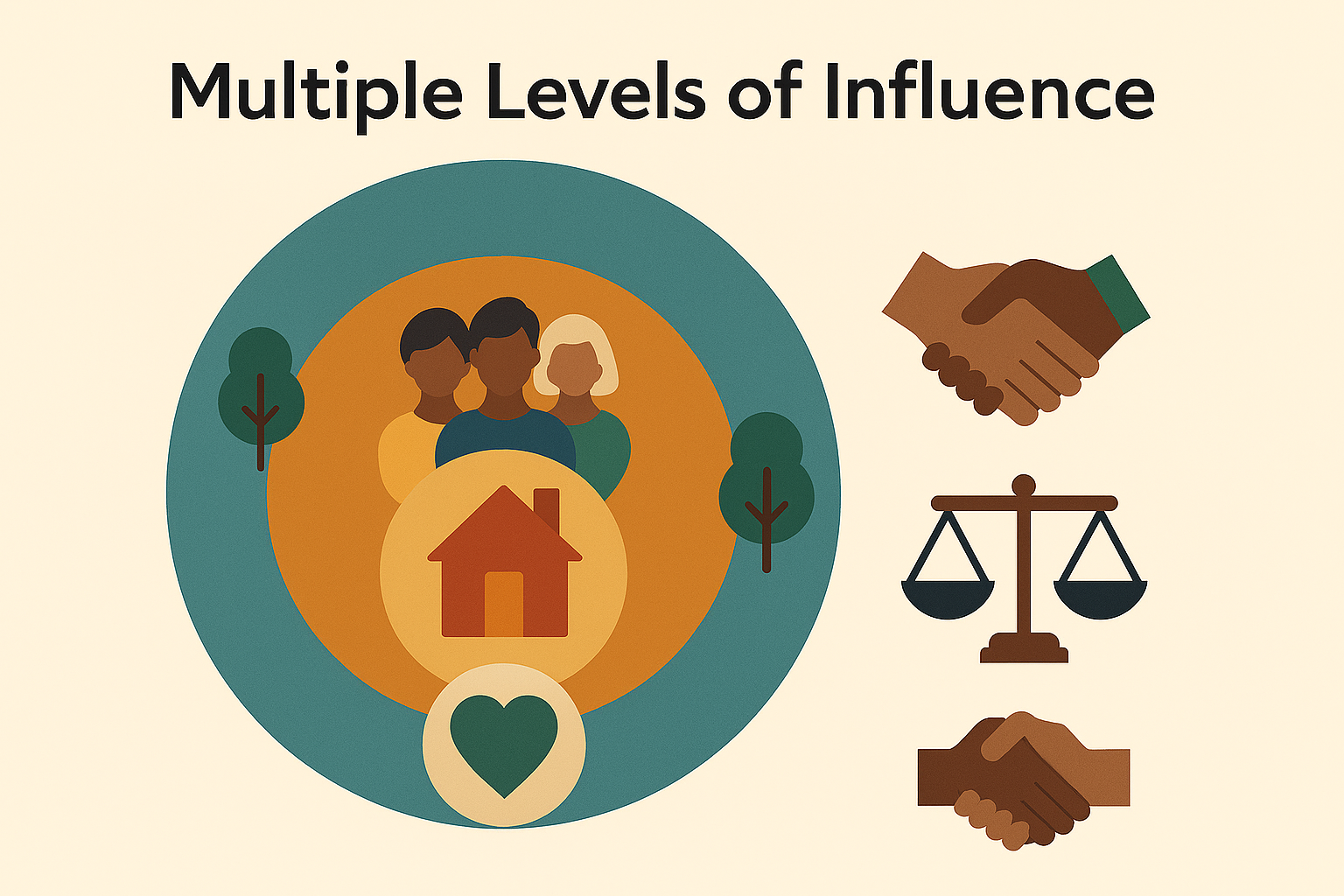
Understanding health inequities requires examining the multiple levels at which determinants operate—from structural and community factors to interpersonal and individual influences. This collection highlights key resources that demonstrate how multilevel frameworks can guide evidence-informed interventions, helping healthcare professionals, including Medical Laboratory Technologists, contextualize laboratory findings within broader societal and environmental determinants.
Scholarly Resources:
1. A Multilevel Approach to Modeling Health Inequalities at the Intersection of Multiple Social Identities
Evans, C. R., McFarland, M. J., & Umberson, D. J. (2018). A multilevel approach to modeling health inequalities at the intersection of multiple social identities. Social Science & Medicine, 210, 136–146. https://doi.org/10.1016/j.socscimed.2018.05.034
Annotation:
This article illustrates how multilevel modeling can assess health inequalities across intersecting social identities, such as race, class, and gender. It highlights the interaction between structural, community, interpersonal, and individual determinants, emphasizing the need to integrate multiple levels of influence when interpreting health outcomes and planning interventions.
2. Multilevel Social Determinants of Individual and Family Well-Being
Browne, D. T., et al. (2024). Multilevel social determinants of individual and family well-being. BMC Public Health. https://pmc.ncbi.nlm.nih.gov/articles/PMC11002224/
Annotation:
This study examines how family, community, and societal determinants intersect to shape individual and family well-being. It demonstrates that health cannot be understood in isolation, highlighting the necessity of multilevel, context-aware approaches in both research and practice to reduce inequities and inform comprehensive healthcare strategies.
Government Resources:
1. Social Determinants of Health and Health Inequalities (Canada)
Type: Government / Public Health Website
Public Health Agency of Canada. (2023). Social determinants of health and health inequalities. Government of Canada. https://www.canada.ca/en/public-health/services/health-promotion/population-health/what-determines-health.html
Annotation:
This federal resource outlines how SDoH, including income, education, housing, employment, and social support, influence health outcomes across personal, social, and environmental levels. It emphasizes that inequities arise from structural conditions and policies, reinforcing the importance of multilevel action to promote health equity.
Summary
This collection emphasizes the importance of examining health through a multilevel lens, showing how structural, community, interpersonal, and individual determinants interact to influence outcomes. Beginning with theoretical modeling and moving to practical Canadian frameworks, these resources help healthcare professionals, including Medical Laboratory Technologists, appreciate the layered nature of health inequities. Collectively, they reinforce the value of context-aware, multilevel strategies to improve population health and guide equitable clinical and public health interventions.