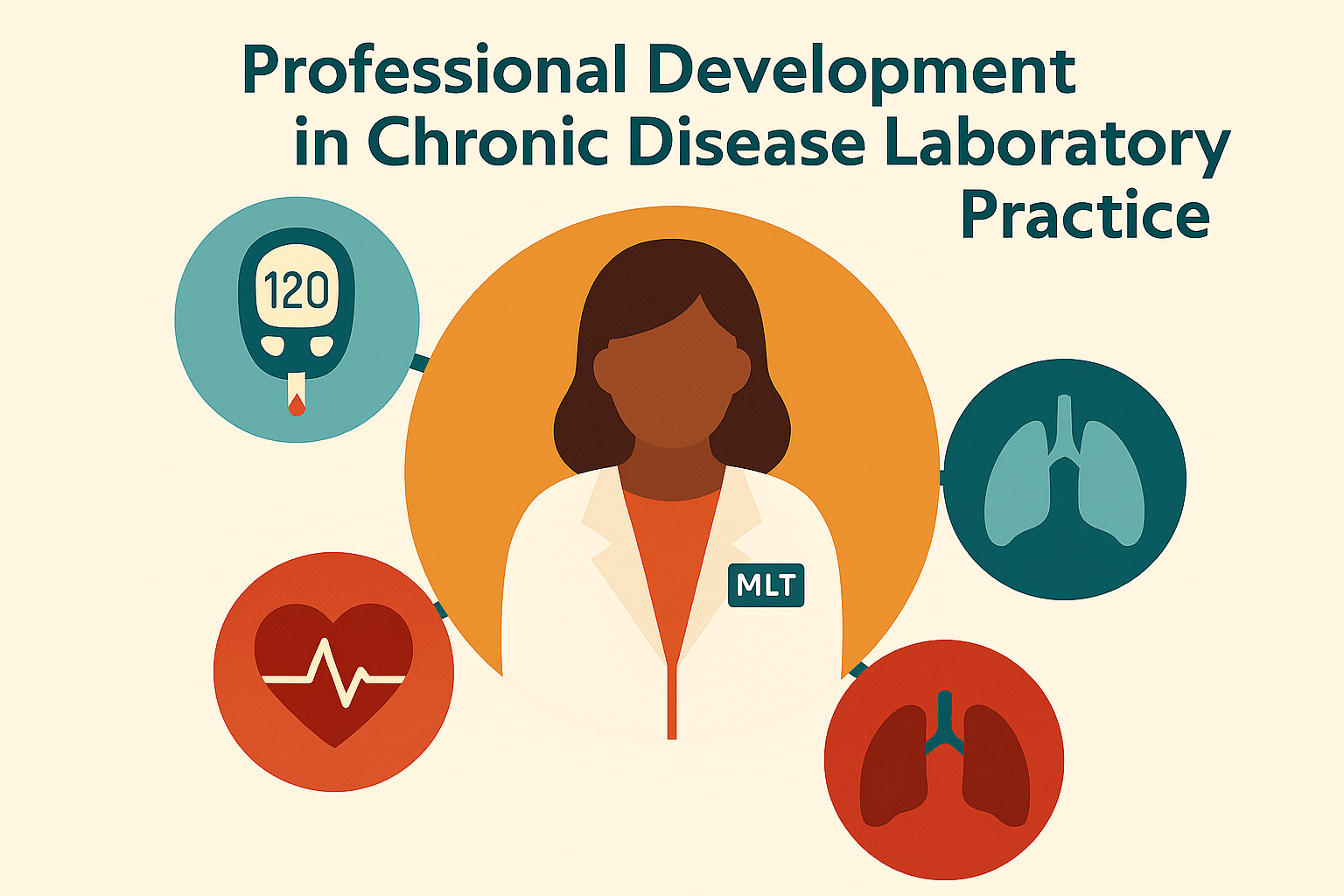
Curated Resources for Professional Development in Chronic Disease Laboratory Practice
Introduction
This resource section consolidates foundational, regulatory, and applied references that support the professional development of Medical Laboratory Technologists (MLTs) in Ontario. It centralizes evidence-based sources on chronic diseases—particularly type 2 diabetes mellitus (T2DM), cardiovascular disease (CVD), and chronic lower respiratory diseases (e.g., COPD)—and their determinants, prevalence, and laboratory management. By integrating peer-reviewed literature, professional standards, government data, and clinical guidelines, this list provides practical guidance for laboratory workflows, clinical collaboration, and population-level health planning.
Scholarly Resources:
1. The Social Ecological Model (SEM) Framework
McLeroy, K. R., Bibeau, D., Steckler, A., & Glanz, K. (1988). An ecological perspective on health promotion programs. Health Education Quarterly, 15(4), 351–377. https://doi.org/10.1177/109019818801500401
Annotation:
Introduces SEM as a framework for understanding multilevel health determinants. Supports analysis of how behavioural, social, and organizational factors affect chronic disease outcomes and laboratory practices.
2. Bronfenbrenner’s Ecological Theory
Bronfenbrenner, U. (1977). Toward an experimental ecology of human development. American Psychologist, 32(7), 513–531. https://doi.org/10.1037/0003-066X.32.7.513
Annotation:
Provides the theoretical basis for nested, interacting systems influencing individual development. Informs SEM application to chronic disease laboratory management.
3. Multilevel Health Inequalities
Evans, C. R., McFarland, M. J., & Umberson, D. J. (2018). A multilevel approach to modeling health inequalities at the intersection of multiple social identities. Social Science & Medicine, 210, 136–146. https://doi.org/10.1016/j.socscimed.2018.05.034
Annotation:
Demonstrates how intersecting social identities influence health outcomes through multilevel determinants. Guides MLTs in interpreting lab results within the context of systemic inequities.
4. Rosella et al.: Evaluation of Ontario Diabetes Education Programs
Rosella, L. C., Lebenbaum, M., Fitzpatrick, T., O’Reilly, D., Wang, J., Booth, G. L., & Lipscombe, L. L. (2020). Evaluating chronic disease prevention programs in Ontario’s Diabetes Education Programs: A population-based cohort study. Canadian Journal of Diabetes, 44(7), 621–628. https://doi.org/10.1016/j.jcjd.2020.02.006
Annotation:
Evaluates the effectiveness of Diabetes Education Programs in Ontario using lab data such as HbA1c and lipid profiles. Supports evidence-based program planning and demonstrates the impact of lab work on patient outcomes.
5. Canadian Chronic Disease Surveillance System (CCDS)
Lix, L. M., Ayles, J., Bartholomew, S., Cooke, C. A., Ellison, J., Emond, V., … Smith, M. (2018). The Canadian Chronic Disease Surveillance System: A model for collaborative surveillance across Canada’s provinces and territories. International Journal of Population Data Science, 3(3), 433. https://doi.org/10.23889/ijpds.v3i3.433
Annotation:
Describes interprovincial chronic disease surveillance and integration of lab and administrative data. Demonstrates how MLT contributions underpin population-level monitoring and health system planning.
Government Resources:
1. Social Determinants of Health in Canada
Public Health Agency of Canada. (2023). Social determinants of health and health inequalities. Government of Canada. https://www.canada.ca/en/public-health/services/health-promotion/population-health/what-determines-health.html
Annotation:
Outlines social determinants affecting health outcomes in Canada. MLTs use it to contextualize patient lab results and consider barriers to care and chronic disease management.
2. Public Health Ontario: Chronic Disease Burden Reports
Public Health Ontario. (2019). The burden of chronic diseases in Ontario: Key estimates to support efforts in prevention. Ontario Agency for Health Protection and Promotion & Cancer Care Ontario. https://www.publichealthontario.ca/-/media/documents/cdburden-report.pdf?la=en
Annotation:
Summarizes prevalence and distribution of chronic diseases across Ontario populations. Helps MLTs anticipate test volumes and interpret results in the context of population health trends.
3. Public Health Ontario: Diabetes Prevalence in Ontario
Public Health Ontario. (2023). Diabetes prevalence in Ontario, 2023. https://www.publichealthontario.ca/en/data-and-analysis/chronic-diseases/diabetes
Annotation:
Provides current prevalence estimates for T2DM in Ontario, including high-risk subgroups. Supports lab workflow planning and interpretation of HbA1c, lipid, and kidney function results.
4. Statistics Canada: Prevalence of Chronic Conditions
Statistics Canada. (2023). Prevalence of chronic conditions among Canadians, 2021. https://www150.statcan.gc.ca/n1/pub/82-570-x/2023001/section1-eng.htm
Annotation:
Offers national prevalence data for chronic diseases including T2DM, CVD, and COPD. Supports interpretation of lab results within a broader epidemiological context.
5. Ontario Ministry of Health: Chronic Disease Prevention Guideline
Ontario Ministry of Health. (2018). Chronic disease prevention guideline, 2018. Queen’s Printer for Ontario. https://files.ontario.ca/moh-guidelines-chronic-disease-prevention-guideline-en-2018.pdf
Annotation:
Outlines provincial best practices for prevention and management of chronic disease. MLTs can integrate this framework into daily testing, reporting, and quality assurance processes.
6. Diabetes Canada: Provincial Backgrounders (Ontario and BC)
Diabetes Canada. (2024). Diabetes in Ontario: Backgrounder. https://www.diabetes.ca/research-%281%29/advocacy-reports/national-and-provincial-backgrounders/diabetes-in-ontario
Diabetes Canada. (2024). Diabetes in British Columbia: Backgrounder. https://www.diabetes.ca/research-%281%29/advocacy-reports/national-and-provincial-backgrounders/diabetes-in-british-columbia
Annotation:
Provides provincial prevalence, risk factors, and surveillance methods. Supports comparison of regional approaches and informs lab priorities and workflow optimization.
7. Province of British Columbia: COPD Guidelines
Province of British Columbia. (2021). Chronic Obstructive Pulmonary Disease (COPD) guideline. https://www2.gov.bc.ca/gov/content/health/practitioner-professional-resources/bc-guidelines/copd
Annotation:
Outlines evidence-based COPD care and monitoring practices in BC. Useful for interprovincial comparisons and understanding how laboratory support integrates with clinical care and surveillance.
Professional and Policy Tool Resources:
1. Accreditation Canada: Medical Laboratory Standards
Accreditation Canada. (2023). Medical laboratory standards overview. https://accreditation.ca
Annotation:
Provides standards for laboratory operations, quality assurance, and workflow management. Supports MLTs in maintaining accurate, timely diagnostic results that inform care decisions for patients with T2DM, CVD, and COPD.
2. Canadian Society for Medical Laboratory Science: Role of MLTs
Canadian Society for Medical Laboratory Science (CSMLS). (2023). The role of the MLT in Canadian health care. https://www.csmls.org
Annotation:
Details professional responsibilities of MLTs, highlighting the impact of timely and accurate laboratory results on chronic disease care, supporting evidence-based practice and interprofessional collaboration.
3. College of Medical Laboratory Technologists of Ontario: Quality Assurance Standards
College of Medical Laboratory Technologists of Ontario (CMLTO). (2024). Quality assurance and professional standards. https://www.cmlto.com
Annotation:
Provides regulatory and professional standards for laboratory practice. Ensures high-quality testing processes critical for monitoring and managing T2DM, CVD, and COPD.
4. Diabetes Canada Clinical Practice Guidelines
Diabetes Canada Clinical Practice Guidelines Expert Committee. (2018). Diabetes Canada 2018 clinical practice guidelines for the prevention and management of diabetes in Canada. Canadian Journal of Diabetes, 42(Suppl 1), S1–S325. https://doi.org/10.1016/j.jcjd.2018.05.006
Annotation:
Provides evidence-based recommendations for T2DM prevention, monitoring, and management. Guides MLTs in aligning laboratory testing and reporting with clinical best practices.
5. Canadian Cardiovascular Society Guidelines
Canadian Cardiovascular Society. (2021). 2021 CCS guideline for the prevention of cardiovascular disease in adults. Canadian Journal of Cardiology, 37(5), 464–481. https://pubmed.ncbi.nlm.nih.gov/33781847/
Annotation:
Offers evidence-based guidance for CVD risk assessment, prevention, and management Laboratory testing, including (lipid profiles, troponins, and kidney function) can be interpreted within a risk-based framework.
6. Heart and Stroke Foundation of Canada: Heart Disease Statistics
Heart and Stroke Foundation of Canada. (2023). Heart disease and stroke statistics in Canada. https://www.heartandstroke.ca/
Annotation:
Provides national statistics on CVD prevalence, morbidity, and mortality. Informs MLT interpretation of cardiac biomarkers and planning for population-level testing needs.
7. Trillium Health Partners: Cardiovascular Wellness and Rehabilitation Program
Trillium Health Partners. (n.d.). Cardiovascular wellness and rehabilitation program. https://www.thp.ca/patientservices/cardiacservices/Pages/Cardiovascular-Prevention-and-Rehabilitation-Program.aspx
Annotation:
Illustrates application of lab data in patient-centred cardiac rehabilitation. Demonstrates the critical link between MLT-generated results and integrated care delivery.
Summary
This comprehensive, curated resource list consolidates professional, regulatory, government, and peer-reviewed literature relevant to MLT practice in chronic disease management. It supports evidence-based workflow, laboratory quality assurance, population health analysis, and interprofessional collaboration. By centralizing these sources, MLTs can link lab results to clinical guidelines, provincial programs, and national surveillance initiatives, ensuring high-quality, patient-centred care across chronic disease pathways.