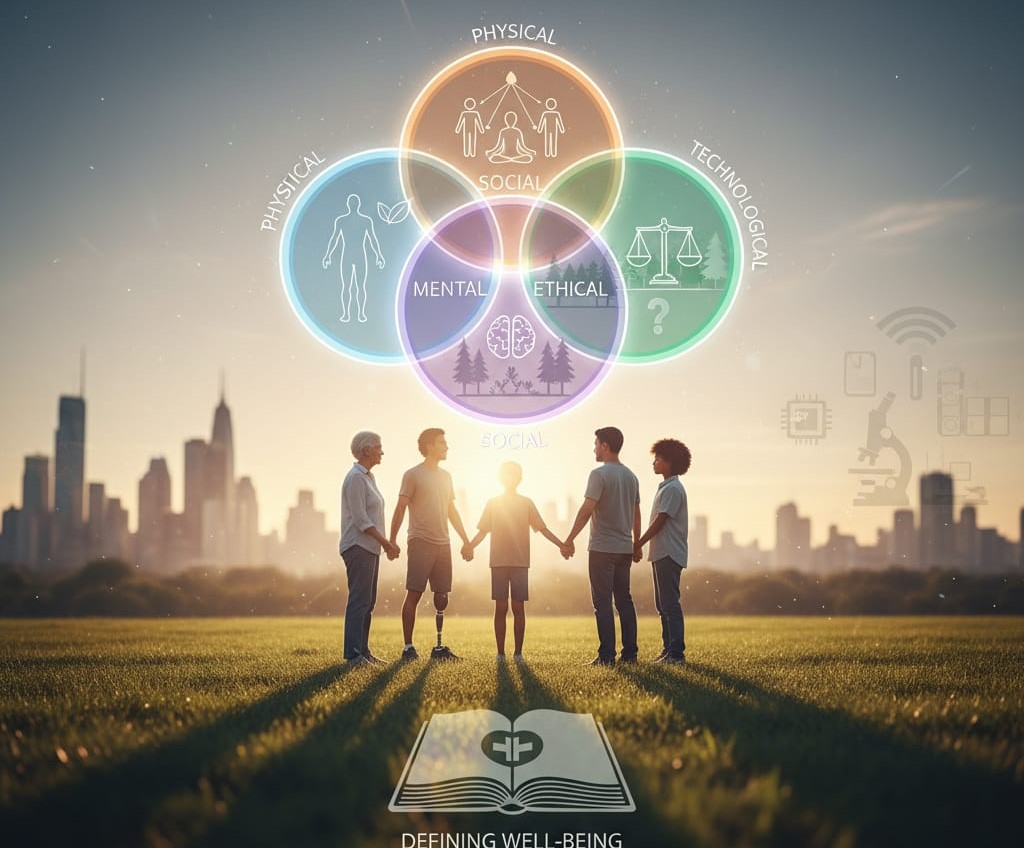
Understanding Health Definitions
The concept of health has changed over time, according to the World Health Organization (1948) health is: ‘a state of complete physical, mental and social well-being and not merely the absence of disease’, but this definition has also been criticized because the expectation of ‘completeness’ is unattainable. It is no longer tenable in the face of the chronicity of disease and the multiplicity of determinants of health that face many people (Huber et al., 2011), and therefore, an individual may be physically well but suffering from chronic depression. Moreover, the use of the word complete makes it impossible to measure health and well-being in modern societies.
More recent definitions of health have shifted from the pursuit of an ideal state to what individuals are capable of doing in the face of the challenges of living, and in this sense, health can be understood as the capacity to cope with demands, to recover from illness, and to perform in social roles (Huber et al., 2011), which is similar to the capacity to adapt and self-manage (Larson, 1999), or the capacity to fulfill roles and accomplish tasks (Krahn et al., 2021). These varying definitions of health all represent a particular piece of the multifaceted, lived experience of health because personal, social, and environmental factors are constantly interacting and influencing each other, such that health is dynamic rather than static. For example, an individual with type 2 diabetes who regularly checks blood glucose levels, adjusts their diet, and recognizes the signs and symptoms of hyper or hypoglycemia is enacting health through adaptation and self-management, and this individual is not the exception to the rule who only “looks healthy” in the clinic, but rather, they are living health on a daily basis through adaptation and self-management.
Reflecting on my classmates’ posts, I have determined that: We need to be adaptable and considerate of context, and this is particularly important in chronic disease, disability, and social determinants of health. Health is not a rigid “wholeness” because it is a functional equilibrium between capacities and limitations in everyday life. Table 1 presents the WHO, Huber, Larson, and Krahn definitions of health, and it also outlines the strengths and weaknesses of each definition. It describes how our understanding of health has evolved from an idealized, static model to a dynamic, real-world perspective, thus providing a more comprehensive view of health.
Table 1. Comparison of Key Definitions of Health and Their Advantages and Disadvantages
| Source | Core Concept | Strengths | Limitations |
| WHO (1948) | Comprehensive physical, mental, and social well-being. | Holistic approach and incorporates mental and social dimensions. | Unrealistic “perfect” health, neglected chronic conditions, and difficult to quantify. |
| Huber et al. (2011) | Capacity to adapt and self-manage. | Practical for contemporary healthcare, emphasizes resilience and functionality, and suitable for chronic illness. | Ignores social aspects and “adaptability” ambiguous. |
| Larson (1999) | Functionality within constraints. | Recognizes personal variations, pertains to everyday activities and environment, and thus is practical. | Philosophical, not quantifiable, and limited utility in policies, therefore not useful for all applications. |
| Krahn et al. (2021) | Fluctuating equilibrium of physical, mental, social, and existential well-being. | Includes existential and social well-being, flexible modern health system, and strength-based perspective on disability, thus is comprehensive. | Broad definition challenging to assess, and “fluctuating equilibrium” subjective, therefore difficult to quantify. |
This comparison implies that there has been a significant change from an understanding of health as static and idealized, to dynamic and contextualized, including resilience and the presence of chronic disease, and social determinants of health, because I feel that the contemporary framework is particularly relevant in this day and age. The stress on adaptability, resilience, and functional well-being rather than a fixed ideal is consistent with a population health approach, which recognizes the social determinants of health (Government of Canada, 2023), and serves as a reminder to clinicians to be flexible and responsive to changing needs and capabilities in the individuals they support, although the 1948 WHO definition is a historically important one, it has been extensively criticized as overly restrictive, idealistic, and impractical (Huber et al., 2011). The modern definitions are more applicable to healthcare and public health policy because they are more inclusive and incorporate new knowledge about health and health determinants, whereas the classical definition was largely a reflection of a complete absence of disease (Huber et al., 2011; WHO, 1948).
References
Government of Canada. (2023). Social determinants of health and health inequalities. Public Health Agency of Canada. https://www.canada.ca/en/public-health/services/health-promotion/population-health/what-determines-health.html
Huber, M., Knottnerus, J. A., Green, L., van der Horst, H., Jadad, A. R., Kromhout, D., … & Smid, H. (2011). How should we define health? BMJ, 343, d4163. https://doi.org/10.1136/bmj.d4163
Krahn, G. L., Walker, D. K., & Correa-De-Araujo, R. (2021). It’s time to reconsider how we define health: Perspective from disability and chronic condition. Disability and Health Journal, 14(4), 101129. https://doi.org/10.1016/j.dhjo.2021.101129
Larson, J. S. (1999). The conceptualization of health. Medical Care Research and Review, 56(2), 123–136. https://doi.org/10.1177/107755879905600201
World Health Organization. (1948). Preamble to the Constitution of the World Health Organization. WHO. https://www.who.int