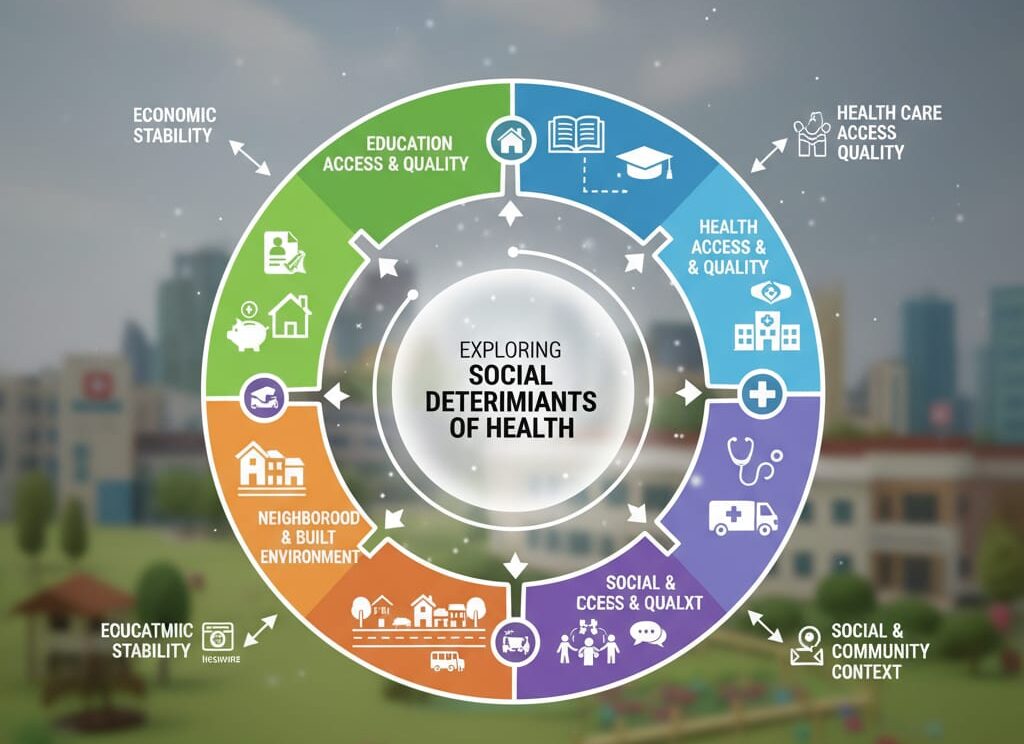
Exploring Social Determinants of Health
Health is not just about personal choices or genetics, but it is about the conditions in which people are born, grow, live, work, and age, which are the conditions that lead to illness, wellness, or access to care. The social determinants of health are the fundamental causes of health inequities, the unfair, avoidable differences in health status that exist within and between countries, because the World Health Organization (n.d.) states that the social determinants of health are the primary causes of health inequities, which are the primary causes of health inequities, such as housing quality, education, income, work conditions, and many others. The social determinants of health directly affect the well-being of an individual, which highlights the need for policies that address the structural drivers of health inequities in order to improve the health of individuals and communities.
It is also important that health professionals understand the social determinants of health in order to help promote equity, because the social determinants of health have been extensively studied, and have proven to have real-world applications. Hacker et al. (2024) looked at unmet social needs and their association with chronic disease in U.S. adults, and they found that financial strain and unstable housing were associated with chronic disease in U.S. adults. Consequently, Alemu et al. (2024) studied the social determinants of health and unmet primary care needs in Canada, and found that income, mental health, and existing chronic conditions predicted unmet primary care needs. Therefore, both of these studies demonstrate how the social determinants of health affect clinical outcomes and access to care, and how the social determinants of health affect the health inequities that exist at the population level.
Definitions of health determine what we measure, what we fund and what we prioritize within the system, and in practice, a disease-specific public health framework drives the prioritization of lab tests and interventions. As a Medical Laboratory Technologist in Ontario, this affects what population health indicators we measure, what resources we are given and how we provide equitable care because it influences our overall approach to healthcare. Through frameworks such as the Ontario Health Social Determinants of Health Framework (Ontario Health, 2025) and the Health Equity Impact Assessment tool (Ministry of Health and Long-Term Care, 2012), we can merge the social determinants of health with biological data to ensure our decision making is more equitable and evidence-informed.
Interactions between digital determinants (electronic health records, telehealth, patient portals), social determinants and biological determinants change the way that care is delivered, with potential for increased access to care and decreased time to follow up with patients, but increased health inequities for marginalized populations based on differences in digital literacy and access to technology (Government of Canada, 2023).
This week reminded me that advancing health equity requires not only the naming of social determinants, but also the building of infrastructure that enables people and systems to be adaptable in real time. As our professor said, adaptability is not only an individual capacity, but also a marker of system strength. Bringing together Ontario Health’s SDOH Framework (2025) and BC’s Determinants of Health Model (2024) is a pragmatic way of tying policy to frontline practice, which involves standardizing data, aligning incentives, and mapping care pathways. When done well, this makes adaptability and equity concrete and measurable outcomes in the everyday practice of care, rather than just ideals.
References:
Alemu, F. W., et al. (2024). Social determinants of unmet need for primary care: A systematic review. Systematic Reviews, 13, 252. https://doi.org/10.1186/s13643-024-02647-5
Gore, D., & Kothari, A. (2012). Social determinants of health in Canada: Are healthy living initiatives there yet? International Journal for Equity in Health, 11(1), 41. https://doi.org/10.1186/1475-9276-11-41
Government of British Columbia. (2022). Cultural Safety & Humility Standard (HSO 75000:2022). Province of British Columbia. https://www2.gov.bc.ca/gov/content/governments/technology-innovation/standards/cultural-safety
Government of British Columbia. (2024, September 4). B.C. Social Determinants of Health Value Set. Province of British Columbia. https://www2.gov.bc.ca/gov/content/health/practitioner-professional-resources/health-information-standards/standards-catalogue/bc-social-determinants-of-health-standards
Government of Canada. (2023). Social determinants of health and health inequalities. Public Health Agency of Canada. https://www.canada.ca/en/public-health/services/health-promotion/population-health/what-determines-health.html
Government of Ontario. (2021). Ontario public health standards 2021. Ontario Ministry of Health. https://www.health.gov.on.ca/en/pro/programs/publichealth/oph_standards/docs/ophs_2021.pdf
Jumah, R., et al. (2023). Indigenous Lens Tool: Aligning health equity frameworks with Indigenous perspectives. Ontario Health. https://www.ontariohealth.ca
Ministry of Health and Long-Term Care. (2012). Health equity impact assessment (HEIA) tool. Ontario Ministry of Health. https://www.health.gov.on.ca/en/pro/programs/heia/
Ministry of Health and Long-Term Care. (2018). Health equity guideline. Ontario Ministry of Health and Long-Term Care. https://www.health.gov.on.ca
Ontario Health. (2025). Ontario Health Social Determinants of Health Framework & Resource Guide. Ontario Health. https://www.ontariohealth.ca
World Health Organization. (n.d.). Social determinants of health. https://www.who.int/health-topics/social-determinants-of-health