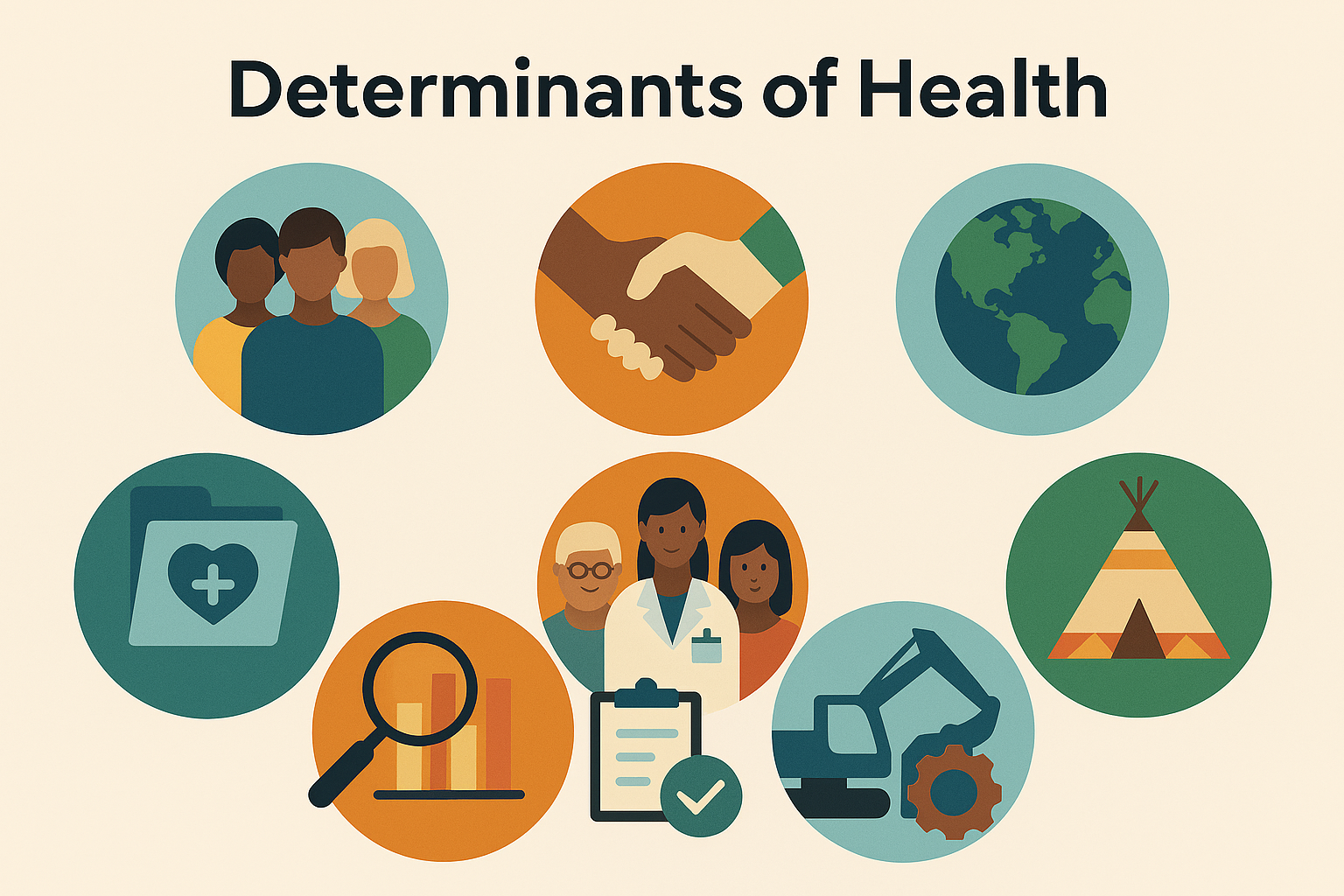
Curated Resources on Determinants of Health
Introduction
As a Medical Laboratory Technologist committed to equitable healthcare, I have curated this collection of resources to deepen my understanding of the social determinants of health (SDOH) and their connection to diagnostic practice. Each source was selected to strengthen my awareness of how societal, cultural, and systemic factors influence health outcomes and access to care. Together, these materials reflect my ongoing growth toward evidence-informed, equity-oriented laboratory leadership.
Scholarly Resources:
1. Social Determinants of Health and Health-Related Social Needs (U.S. Context)
Hacker, K., et al. (2024). Social determinants of health and health-related social needs. Preventing Chronic Disease, 21, E62. https://www.cdc.gov/pcd/issues/2024/24_0362.htm
Annotation:
This study explores how unmet social needs such as housing and financial instability contribute to chronic disease inequities in the U.S. It provides strong empirical support for understanding how social factors directly impact disease outcomes, reinforcing similar trends observed in Canadian populations.
2. Social Determinants of Unmet Need for Primary Care: A Systematic Review (Canadian Context)
Alemu, F. W., Raji, S. D., Anderson, C., Khan, S., & Wong, S. T. (2024). Social determinants of unmet need for primary care: A systematic review. Systematic Reviews, 13, 252. https://doi.org/10.1186/s13643-024-02647-5
Annotation:
This Canadian systematic review examines how income, mental health status, and chronic illness affect access to primary care. It underscores the importance of integrating social determinants into health planning, directly informing the rationale for Ontario’s equity-focused tools.
3. Social Determinants of Health in Canada: Are Healthy Living Initiatives There Yet?
Gore, D., & Kothari, A. (2012). Social determinants of health in Canada: Are healthy living initiatives there yet? International Journal for Equity in Health, 11(1), 41. https://doi.org/10.1186/1475-9276-11-41
Annotation:
This article examines the effectiveness of Canadian public health initiatives in addressing SDOH. It’s included to provide critical context on gaps and progress in national policies and programs, adding depth to the curated collection.
Government Resources:
1. Social Determinants of Health (Global Perspective)
World Health Organization. (n.d.). Social determinants of health. https://www.who.int/health-topics/social-determinants-of-health
Annotation:
This document introduces the concept of social determinants of health globally, outlining how social and economic conditions shape health and inequities. It emphasizes the importance of policies addressing these determinants, helping me frame laboratory findings in the broader context of societal and environmental influences.
2. Social Determinants of Health – Healthy People 2030 (Federal Framework)
Office of Disease Prevention and Health Promotion. (n.d.). Social determinants of health. U.S. Department of Health and Human Services. https://odphp.health.gov/healthypeople/priority-areas/social-determinants-health
Annotation:
This U.S. federal framework identifies five major domains of social determinants: economic stability, education, healthcare access, neighborhood environment, and community context. It offers a structured, policy-based model that aligns closely with Canadian priorities, providing a useful comparative lens.
3. B.C. Social Determinants of Health Value Set (Provincial Framework)
Government of British Columbia. (2024, September 4). B.C. social determinants of health value set. https://www2.gov.bc.ca/gov/content/health/practitioner-professional-resources/health-information-standards/standards-catalogue/bc-social-determinants-of-health-standards
Annotation:
This BC publication standardizes how SDOH data is collected and reported across health systems. It demonstrates how equity can be embedded through governance and data standards, highlighting a structural approach to translating national policy into provincial practice.
4. Cultural Safety & Humility Standard (HSO 75000:2022) (Provincial Implementation)
Government of British Columbia. (2022). Cultural safety & humility standard (HSO 75000:2022). https://www2.gov.bc.ca/gov/content/governments/technology-innovation/standards/cultural-safety
Annotation:
This BC standard defines system-wide expectations for culturally safe and respectful care, including mandatory training for health professionals. It complements the BC Value Set by operationalizing cultural safety within equity frameworks—a key example of how policy becomes practice.
5. Ontario Health Social Determinants of Health Framework & Resource Guide (Provincial Framework)
Ontario Health. (2025). Ontario health social determinants of health framework & resource guide. https://www.ontariohealth.ca
Annotation:
Ontario Health’s framework offers a practical model for integrating SDOH into organizational planning. It’s included again because it provides the foundation for Ontario’s equity tools, such as the Indigenous Lens and HEIA, connecting high-level strategy to front-line action.
6. Social Determinants of Health and Health Inequalities (Canada)
Government of Canada. (2023). Social determinants of health and health inequalities. Public Health Agency of Canada. https://www.canada.ca/en/public-health/services/health-promotion/population-health/what-determines-health.html
Annotation:
This federal Canadian resource provides a national overview of SDOH, including their impact on health inequities and policy implications. It complements provincial frameworks by offering a country-wide perspective on determinants affecting access to care and population health.
7. Ontario Public Health Standards 2021
Government of Ontario. (2021). Ontario public health standards 2021. Ontario Ministry of Health. https://www.health.gov.on.ca/en/pro/programs/publichealth/oph_standards/docs/ophs_2021.pdf
Annotation:
This document outlines Ontario’s provincial public health standards, including SDOH-related expectations. It’s included to connect regulatory requirements to practical SDOH implementation and accountability in local health units.
Government and Policy Tools Resources:
1. Indigenous Lens Tool (Culturally Informed Framework)
Jumah, R., Smith, M., & Ontario Health. (2023). Indigenous lens tool: Aligning health equity frameworks with Indigenous perspectives. https://www.ontariohealth.ca
Annotation:
This tool guides health organizations in embedding Indigenous perspectives into policies and programs. It expands the Ontario framework by centering Indigenous worldviews and equity priorities, ensuring culturally safe care across systems.
2. Health Equity Impact Assessment (HEIA) Tool (Applied Equity Assessment)
Ministry of Health and Long-Term Care. (2012). Health equity impact assessment (HEIA) tool. Government of Ontario. https://www.health.gov.on.ca/en/pro/programs/heia/
Annotation:
The HEIA tool supports organizations in evaluating how policies and programs affect health equity. It’s included again to show how Ontario operationalizes its provincial framework, translating theoretical equity principles into measurable action.
3. Health Equity Guideline (Policy Direction and Accountability)
Ministry of Health and Long-Term Care. (2018). Health equity guideline. Government of Ontario. https://www.health.gov.on.ca
Annotation:
This guideline outlines how public health organizations embed equity into planning and evaluation. It’s included again because it provides the accountability structure linking Ontario’s various equity tools, ensuring consistency across all programs and regions.
Summary
This collection of curated resources illustrates how the concept of health equity moves from global theory to local implementation. Beginning with the World Health Organization’s global framework and narrowing down to Ontario-specific tools, each resource supports my professional growth as an MLT by linking social determinants of health to evidence, ethics, and system-level accountability. Collectively, they demonstrate my evolving understanding of how laboratory professionals can contribute meaningfully to health equity through data integrity, advocacy, and culturally informed practice.