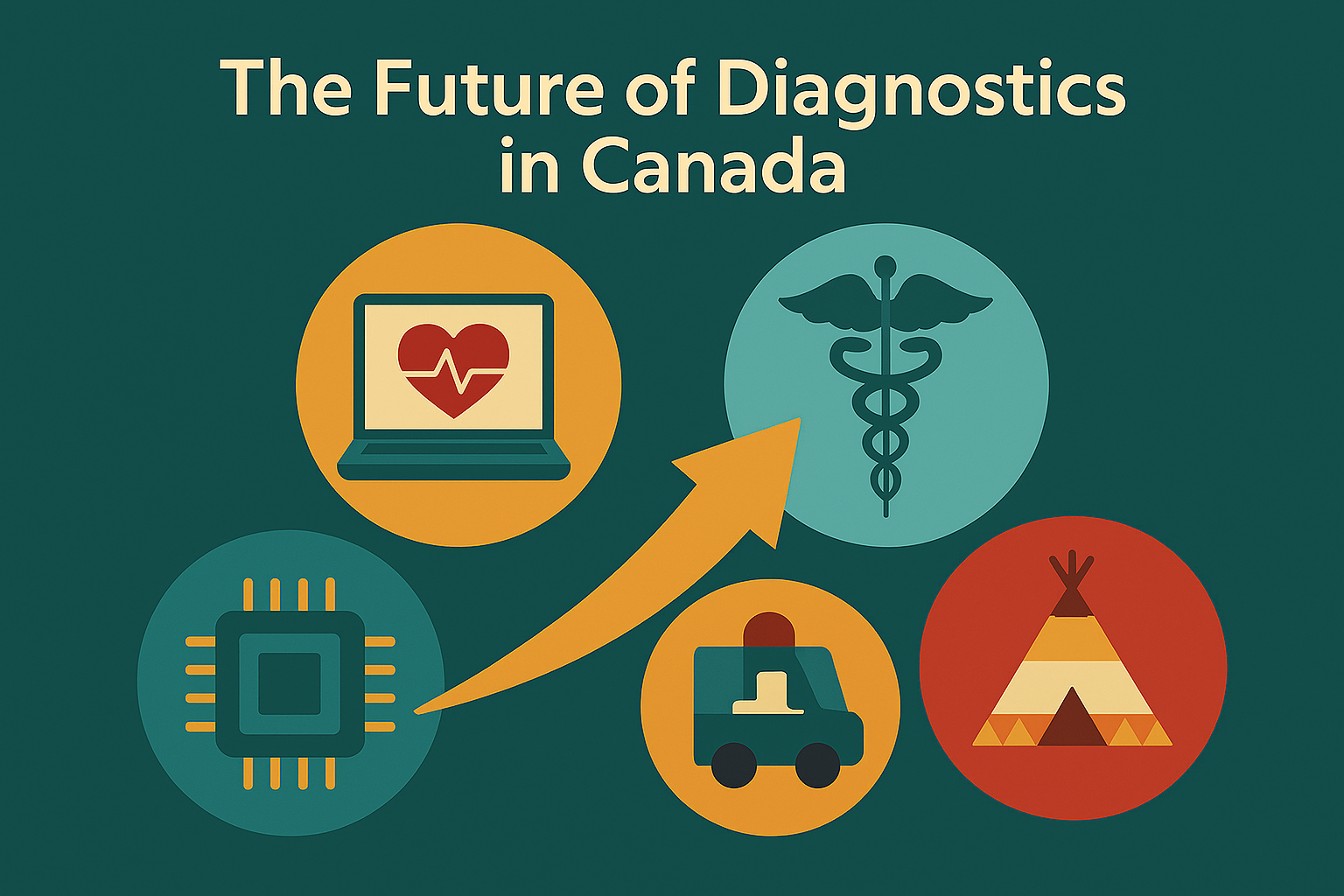
Curated Resources on the Future of Diagnostics in Canada
Introduction:
As a Medical Laboratory Technologist (MLT) in Ontario, I selected these resources to explore how diagnostics in Canada are evolving through technological innovation, equity-oriented practice, Indigenous-led models of care, and system-wide digital transformation. These materials offer insight into emerging diagnostic technologies, issues of access and oversight, culturally safe care models, and the data-driven future of health systems. Together, they reflect a forward-looking and equity-grounded understanding of where Canadian diagnostics are heading and what this means for my role as an MLT.
Government & System-Level Health Resources
1. Canadian Institute for Health Information (CIHI)
Canadian Institute for Health Information. (2024). Annual report 2023–2024. CIHI. https://www.cihi.ca/sites/default/files/document/cihi-annual-report-2023-2024-en.pdf
Annotation:
CIHI provides national health system data, trend analyses, and performance metrics. This resource helps me understand diagnostic capacity, health inequities, regional gaps in testing access, and system pressures across Canada. As an MLT, CIHI’s reporting guides my understanding of where diagnostic inequities begin and how system-level reforms shape lab practice, digital health adoption, and resource planning.
2. Canada Health Infoway, Digital Health Landscape
Canada Health Infoway. (2023). Canadian digital health survey 2023: Virtual care and digital health uptake. https://insights.infoway-inforoute.ca/2023-digital-health-survey
Annotation:
This national survey examines Canadians’ use of virtual care, digital tools, and patient portals. For MLTs, Infoway’s findings are critical to understanding how patients access test results, navigate digital systems, and experience diagnostic care. These insights help ensure that digital transformations in lab medicine are patient-centred and do not widen access gaps in underserved or digitally excluded communities.
Scholarly and Peer-Reviewed Diagnostic Resources
1. Genomic Diagnostics and Health Technology Assessment (HTA)
Husereau, D., Bombard, Y., Stockley, T., Carter, M., Davey, S., Lemaire, D., Nohr, E., Park, P., Spatz, A., Williams, C., & Feilotter, H. (2023). Future role of health-technology assessment for genomic medicine in oncology: A Canadian laboratory perspective. Current Oncology, 30(11), 9660–9669. https://doi.org/10.3390/curroncol30110700
Annotation:
This peer-reviewed Canadian article explores the challenges of implementing genomic testing through HTA frameworks. It identifies regulatory inconsistencies, limited oversight, and inequities in precision-diagnostic access. As an MLT, this resource deepens my understanding of how rapidly emerging genomic technologies must be evaluated to ensure safe, equitable, and evidence-based incorporation into Canadian diagnostic workflows.
2. Policy Horizons Canada, AI and Future Health System Governance
Policy Horizons Canada. (2025). Foresight on artificial intelligence: Implications for health systems policy and governance. Government of Canada. https://publications.gc.ca/collections/collection_2025/hpc-phc/PH4-210-2025-eng.pdf
Annotation:
This foresight document examines how artificial intelligence may transform Canada’s healthcare systems and outlines ethical, regulatory, and governance pathways. For MLTs, this resource highlights the importance of accountable AI deployment in diagnostic interpretation, workflow automation, and data governance. It supports the case for implementing AI in ways that enhance diagnostic quality without reinforcing inequities.
Community and Indigenous Health Diagnostic Innovations
1. Kidney Check: Indigenous-Led Point-of-Care Testing (POCT)
Curtis, S., Martin, H., DiNella, M., Lavallee, B., Chartrand, C., McLeod, L., Woods, C., Dart, A., Tangri, N., Rigatto, C., & Komenda, P. (2021). Kidney Check point-of-care testing—Furthering patient engagement and patient-centered care in Canada’s rural and remote Indigenous communities: Program report. Can-SOLVE CKD. https://cansolveckd.ca/publications/kidney-check-point-of-care-testing-furthering-patient-engagement-and-patient-centered-care-in-canadas-rural-and-remote-indigenous-communities-program-report/
Annotation:
Kidney Check is an innovative diagnostic program delivering POCT to rural and remote Indigenous communities using culturally grounded engagement. This model demonstrates how community-led diagnostics can strengthen early detection, trust, and equity. As an MLT, this resource shows how decentralized testing can close diagnostic gaps and support reconciliation through culturally safe diagnostic pathways.
Professional Resources
1. Canadian Society for Medical Laboratory Science (CSMLS)
Canadian Society for Medical Laboratory Science. (2025). Canadian Journal of Medical Laboratory Science: Spring 2025—AI & digital transformation (special issue). https://csmls.org/wp-content/uploads/2025/04/SPRING25_CJMLS_Digital_EN.pdf
Annotation:
This professional resource discusses the impact of AI, digital workflows, and automation on laboratory practice. It provides a frontline perspective on workforce readiness, emerging competencies, and ethical implementation. For an MLT, this resource directly informs evolving practice expectations, continuing education, and the future skill set required to navigate rapidly changing diagnostic environments.
Summary:
Together, these curated resources form a comprehensive foundation for understanding how diagnostics in Canada are transforming across technological, cultural, and policy dimensions. The peer-reviewed HTA article clarifies how genomic diagnostics must be evaluated; CIHI and Infoway provide national context on health system performance and digital readiness; Indigenous-led POCT demonstrates community-centred innovation; and CSMLS offers an MLT-specific lens on digital transformation. Policy Horizons adds a forward-looking governance perspective, ensuring an ethical and equitable approach to AI adoption. As a whole, this collection strengthens my ability to critically evaluate the future of diagnostics and supports the development of an informed, equity-oriented, technologically competent laboratory practice.