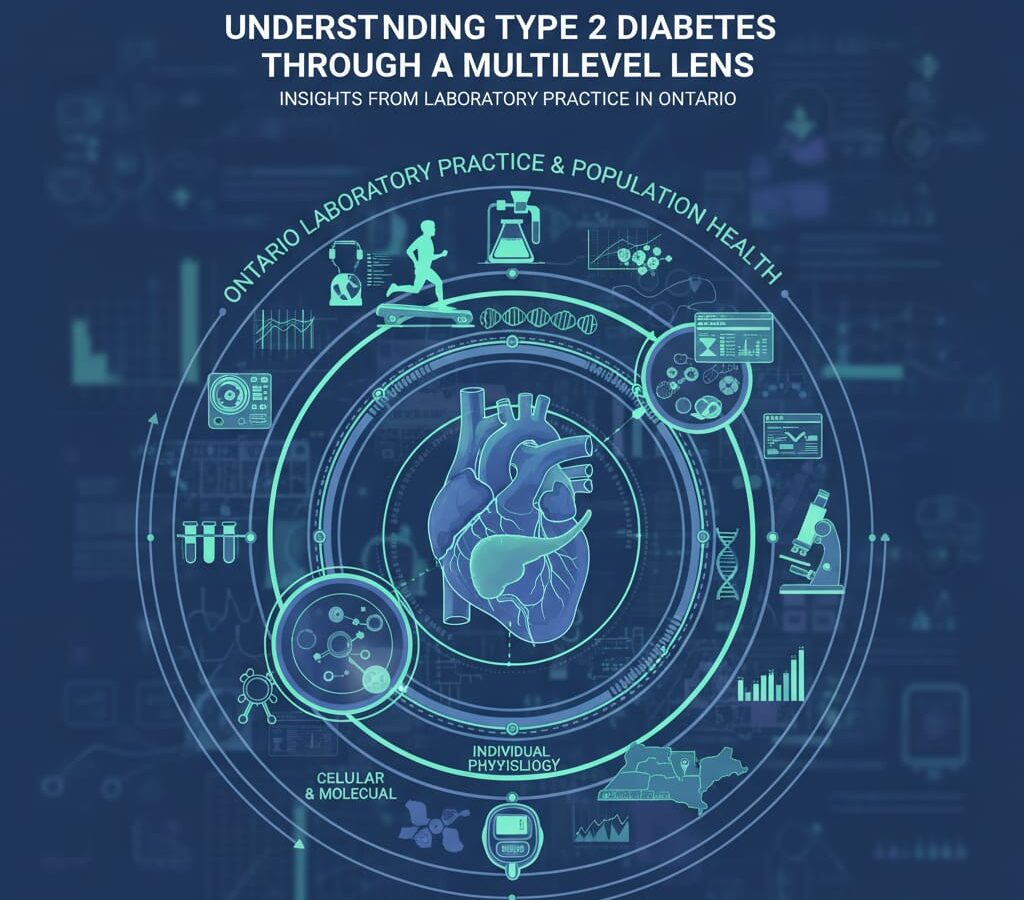
Understanding Type 2 Diabetes Through a Multilevel Lens: Insights from Laboratory Practice in Ontario
Overview
Type 2 diabetes (T2D) is a chronic disease, which affects millions of Canadians and the management of T2D requires an intersectoral approach to policy and practice at all levels of public policy, healthcare system, community and individual behaviour. As a Medical Laboratory Technologist (MLT), I have seen the importance of diagnostic testing (e.g. HbA1c, fasting glucose, and lipid panels) for early detection, ongoing monitoring and treatment decision-making because this information is crucial for effective disease management.
The Social Ecological Model (SEM) offers a valuable framework to examine the societal, community, organizational, interpersonal, and individual-level factors influencing T2D outcomes (Evans, McFarland, & Umberson, 2018), and therefore, application of this model in Ontario may inform where targeted interventions are most likely to have a positive impact on outcomes for individuals with T2D, from policy-level changes, accessible community-based programs, organisational protocols, support from family and social networks, to patient-centred self-management.
Application of the SEM to T2D in Ontario
1. Policy Level
Policy decisions inform the framework for access to care and prevention, and in Ontario, OHIP coverage of routine lab testing and diabetes education, as well as provincial initiatives like the Ontario Diabetes Strategy (Government of Ontario, 2021) that emphasize early detection, patient education and integrated care, are examples.
The policy level can assist MLTs in understanding the effect of funding models, screening programs and provincial directives on equitable access to lab services and long-term T2D management because it highlights the need for consistent coverage, clear screening guidelines and continued investment in education and integrated care pathways for timely testing, follow-up and improved outcomes.
2. Community Level
Community-level factors influence how individuals access care and interact with the health care system as a whole, which includes the availability of culturally sensitive diabetes education programs, community-based wellness programs that promote physical activity and healthy eating, and the availability of rural or remote clinics for laboratory testing (Public Health Agency of Canada [PHAC], 2023). The awareness of community-level factors allows laboratory professionals to interpret results with a deeper understanding of the social determinants of health and an individual’s ability to seek prevention, testing, and ongoing monitoring for T2D, because this awareness enables them to consider the broader context in which individuals interact with the health care system.
3. Organizational Level
Policies and organizational structures can also influence day-to-day work flows and quality of care because standardized hospital and community lab protocols enable timely processing and reporting of tests. EMRs can flag overdue HbA1c and lipid tests with automated alerts to trigger timely follow-up, and integrated care pathways can also link lab results to patient counseling and education, enabling providers to take timely and consistent action on abnormal values (Ontario Health, 2025). Collectively, these enhancements, such as automation and integrated reporting, can facilitate streamlined work flows, reduce delays, and enhance follow-up and cross-disciplinary care coordination, therefore resulting in more consistent monitoring, more rapid interventions, and improved support for people living with T2D.
4. Interpersonal Level
Interpersonal relationships and patient motivation and adherence, such as family and caregiver support to reinforce medication routine and day-to-day lifestyle changes, peer influence from community groups to support healthy habits and accountability, and clear and empathetic communication between healthcare providers and patients to facilitate understanding of laboratory results and next steps (Browne et al., 2024), are crucial. By recognizing these interpersonal influences, MLTs can interpret laboratory results with empathy, considering the patient’s support systems and real-world challenges, and connecting data to actionable, patient-centred care.
5. Individual Level
Ultimately, individual-level factors determine what a patient will do with the lab result and what the health outcome will be, because health literacy and numeracy determine how a patient interprets lab reports (Evans et al., 2018), and motivation determines the degree to which a patient adheres to diet, exercise, and medication recommendations, while biological factors such as age, genetics, and comorbidities determine outcomes (Evans et al., 2018). Lab data is only a part of the story, but when lab data is interpreted in the context of behavioral, psychosocial, and biological information, the complete story of the patient is revealed, and therefore, more patient-centered care is possible.

Conclusion
The Social Ecological Model provides a useful and practical framework to examine T2D in Ontario, which demonstrates how policy and individual behaviours and other factors interplay to shape outcomes, and for MLTs, this model emphasizes the importance of diagnostic services within the context of a multidisciplinary continuum of care. By combining lab data with multilevel determinants, healthcare providers are better positioned to identify challenges, promote equity, and support comprehensive and patient-centered chronic disease management.
References:
Browne, D. T., et al. (2024). Multilevel social determinants of individual and family well-being. BMC Public Health. https://pmc.ncbi.nlm.nih.gov/articles/PMC11002224/
Evans, C. R., McFarland, M. J., & Umberson, D. J. (2018). A multilevel approach to modeling health inequalities at the intersection of multiple social identities. Social Science & Medicine, 210, 136–146. https://doi.org/10.1016/j.socscimed.2018.05.034
Public Health Agency of Canada. (2023). Social determinants of health and health inequalities. Government of Canada. https://www.canada.ca/en/public-health/services/health-promotion/population-health/what-determines-health.html
Ontario Health. (2025). Ontario Health Social Determinants of Health Framework & Resource Guide. Ontario Health. https://www.ontariohealth.ca
Government of Ontario. (2021). Ontario public health standards 2021 [PDF]. Ontario Ministry of Health. Retrieved from: https://www.ontario.ca/page/ontario-public-health-standards-requirements-programs-services-and-accountability